
One House, Six Characters: What Brick Slips Are and Why They Change Everything

Same plot. Same garden. Same light falling across the same front door. And yet, swap the finish on the walls and you are looking at six completely different homes.
That was the idea behind a set of concept designs we shared on Instagram this week. One house, drawn six times, each with a different brick or render finish. The response told us something we already suspected: most people assume the character of a house is fixed the moment the shape is drawn. It isn't. A great deal of what makes a home feel like a Victorian villa, a Georgian townhouse or a quiet country cottage lives in the surface.
The part most people do not expect is this. None of these homes needs to be built brick by brick. Every one of them can be finished in brick slips.
So what are brick slips, why are we so interested in them, and are they right for your self-build? Here is what you need to know.
What are brick slips?
Brick slips are thin slices of real fired clay brick, usually around 15 to 25mm deep, rather than the full 102.5mm of a standard brick. They are either cut from the face of a whole brick or made as slips from the start. Once fixed and pointed with mortar, they look and weather exactly like traditional brickwork, because they are the same material.
Corner pieces, often called pistol slips, wrap around the edges of a building so the illusion holds from every angle. Look at a well finished brick slip home from the pavement and you will not be able to tell.
The difference is what sits behind them. A traditional English house has a full brick outer wall, a cavity, and a block inner wall. With brick slips, that heavy outer layer is replaced by a slim clay face fixed to a modern, highly insulated structure. That structure might be a timber frame, structural insulated panels (SIPs), insulated concrete formwork (ICF) or blockwork.
There are three main ways slips are fixed:
Adhered slips: bonded with a specialist adhesive onto a prepared board or wall, then pointed.
Insulated board systems: slips sit in a profiled insulation board that holds every course level, so the wall gets extra insulation and a brick finish in one layer.
Mechanically fixed systems: slips clip onto steel or aluminium rails. These are the systems used on taller and more demanding buildings.
This is one of the reasons brick slips sit so comfortably within modern methods of construction. Much of the build can happen off site or in a dry, controlled way, with the brick finish going on at the end.
One house, six characters
Put the six designs side by side and the shape barely registers. What you notice is mood. Colour, texture and the way a wall holds the light do more to set the character of a home than almost any other single decision.
Here is how the same house shifts as the finish changes:

Warm red. The most familiar English brick. It feels rooted and settled, the kind of house that looks like it has always been there.

Soft buff. Lighter and gentler, with a Cotswold warmth that suits rural lanes and leafy edges of town.

Pale chalk. Calm and bright. It reflects light back into the garden and gives the house a quiet, contemporary edge without losing its traditional bones.

London stock yellow. Mottled and characterful, with the slightly weathered look of a period townhouse.

Soft render with buff brick detail. Render on the main walls, with brick picking out the plinth, corners and window heads. Restrained, elegant and very easy to live with.
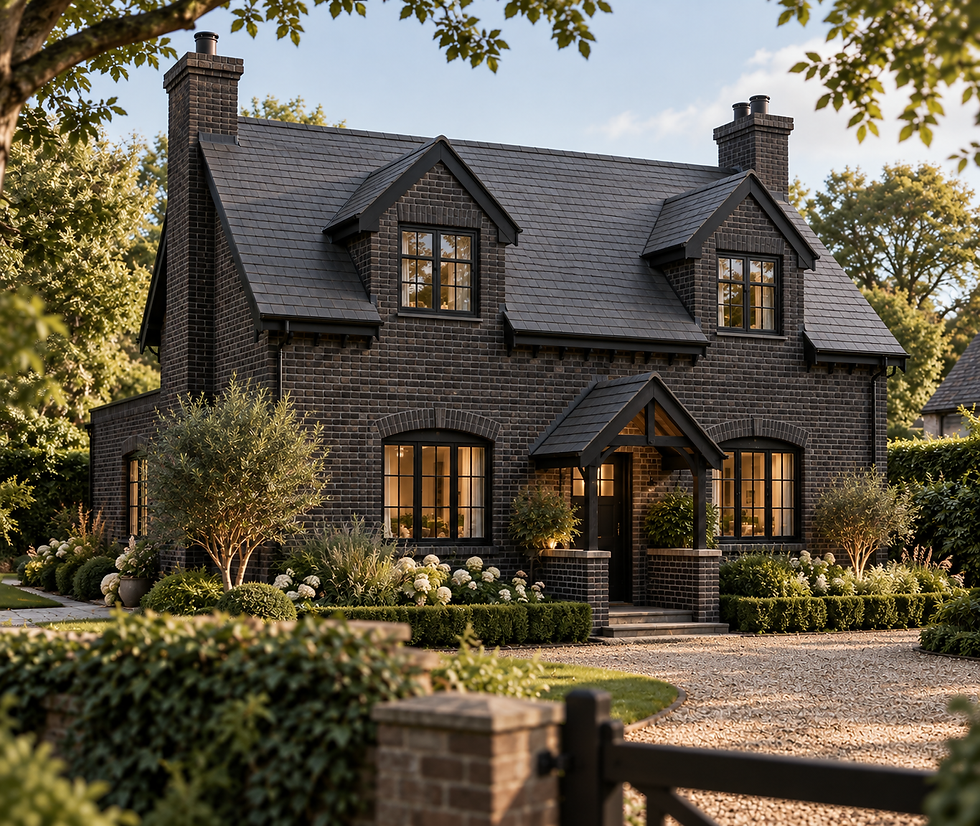
Charcoal. Deep and modern. Against a green garden it is striking, letting planting and timber take centre stage.
Nothing about the plan, the room sizes or the energy performance changes between these six homes. What changes is how the house sits in its setting, and how it feels to come home to. We explored the same idea through regional character in Four Traditional English House Styles, Built for the Way We Live Now. Brick slips are one of the practical ways that character becomes buildable.
These are concept designs rather than finished schemes.
Which one feels like home to you? Tell us on Instagram, we would love to know.
The benefits of brick slips
1. Character without compromise on energy. Because the outer leaf is slim, more of the wall's depth can go to insulation. Some systems, such as Eurobrick's X-Clad, build the insulation into the backing board itself. You get the look of a traditional English house with the performance of a modern, low energy one. That pairing sits at the heart of how we think about sustainable homes worth sustaining.
2. A faster, cleaner build. Brick slips usually go onto a frame that is already up and weathertight. Less wet mortar and less site time mean fewer weather delays. Wienerberger notes that using less mortar and water makes for a much cleaner site than conventional brickwork.
3. Lighter walls, simpler foundations. A full brick outer leaf is heavy. Slip systems weigh a fraction of that. The MechSlip system from Ibstock Kevington and Ash & Lacy, for example, is more than 50% lighter than traditional masonry. Lighter walls can mean slimmer foundations, which matters on tricky plots.
4. More floor space. A slimmer wall build-up gives back internal space on the same footprint. On a tight plot, a few centimetres on every external wall adds up.
5. Real clay, real ageing. Unlike brick effect panels, genuine clay slips weather the same way traditional brickwork does. They mellow over time rather than fading or looking tired.
6. Freedom of finish. Because slips come in hundreds of blends, you can choose the character that suits your setting, or match a local vernacular to help your design sit comfortably with planners and neighbours.
7. Lower embodied material. A slip uses only a fraction of the clay of a whole brick, so less material is fired and transported for the same finished look. It is one of many small choices we explore in Choose Sustainable Materials for Greener Construction.
What to think about before you choose brick slips
Brick slips are a brilliant tool, but the finish is only as good as the system and the detailing behind it. These are the questions we always ask.
Is it a tested, certified system? On the outside of a home, slips should be part of a complete system where the slip, adhesive, board and fixings are tested together. Warranty providers expect this. LABC Warranty requires third party accreditation for brick slip cladding systems, such as BBA or BRE certification.
What is its fire rating? External walls must meet Approved Document B of the Building Regulations. Fire performance is classified from A1 (best) down to F under BS EN 13501-1. Most single family homes sit well below the 18 metre threshold where the strictest rules apply, but walls near a boundary still have requirements. A good supplier will provide the test data without hesitation.
Will planners approve the finish? Planning permissions usually include a condition asking for samples of external materials. Choosing a slip that responds to the local vernacular, rather than fighting it, makes that conversation far easier. Our planning consultancy team considers this from the first sketch.
Are the details right? Corners, window reveals, sills, damp proof courses and movement joints are where brick slip homes succeed or fail. Pistol corners, matching special shapes and properly carried through movement joints keep the illusion convincing and the wall watertight.
What will it cost? Prices vary widely by product and system. As a guide, The Brick Tile Company's reclaimed-style clay slips are listed at around £82 to £85 per square metre for the slips alone, before adhesive, pointing and installation. Full insulated or mechanically fixed systems cost more, but can save time and foundation costs elsewhere. If you are weighing up the bigger numbers, our post Is Self-Build Actually Cheaper Than Buying a New House? is a good place to start.
Who supplies brick slips in the UK?
The market has grown quickly, and there are now specialists for every kind of project. A few names worth knowing:
The Brick Tile Company offers real clay slips in three collections: Reclaimed (rustic and weathered), Traditional, and Contemporary (smooth and sleek). Their range runs from warm reds through to pale chalk tones, and they supply the adhesive, mortar and primer to go with them. A great place to start if you want to see colours in person, as they sell samples.
Wienerberger is one of the UK's largest brick makers and offers both manufactured brick slips and Corium, a mechanically fixed brick tile system distributed by Taylor Maxwell.
Eurobrick was the first company to bring insulated brick slip cladding to the UK, in the early 1990s. Its systems pair clay slips with insulation boards for new build, retrofit and modular homes.
MechSlip, developed by Ibstock Kevington and Ash & Lacy, is a mechanically fixed system using Ibstock brick, with an A1 fire rating.
The right choice depends on your frame, your budget and your setting. It is always worth ordering physical samples and seeing them outside, in daylight, against your plot's planting. Colours read very differently on a screen.
Character is a choice
For a long time, people felt they had to pick between a house that looks and feels traditional and one that performs like a modern home. Brick slips quietly remove that choice. The warmth of real clay, the familiarity of an English street, the comfort of a well insulated, efficient home. All of it, together.
It also changes how we think about designing a self-build. If the finish can shift this much without touching the plan, you can focus first on how you want to live in the house, then decide how you want it to feel from the garden gate. That is exactly how we like to work, designing around your lifestyle, not just your plot.
If you are thinking about building your own home in Hertfordshire or the South of England, explore our self-build plots or get in touch with the team. And if you are still in the early stages, our guide to the 10 things to check before buying a building plot is a good first read.
Frequently asked questions about brick slips
What are brick slips made of?
Quality brick slips are made of real fired clay, the same material as a standard brick. They are cut from whole bricks or manufactured as thin slips, usually 15 to 25mm deep. Resin and brick effect products also exist, but they do not age in the same way.
Can you tell the difference between brick slips and real brick?
Not when they are well installed. Brick slips are real brick, pointed with mortar, and corner pieces wrap around the edges. From the street, a brick slip house looks like a traditionally built one.
Are brick slips good for a new build or self-build home?
Yes. They pair well with timber frame, SIPs and ICF, which are popular for self-build because they are fast and energy efficient. Brick slips give those homes a traditional English character.
Are brick slips cheaper than traditional brickwork?
Sometimes. The slips alone are not always cheaper per square metre than bricks. Savings usually come from faster build times, lighter walls, simpler foundations and less time lost to weather.
Do brick slips need planning permission?
On a new home, the external finish is part of your planning application and is often confirmed later through a materials condition. Adding slips to an existing house may need permission, especially in conservation areas or on listed buildings. Check with your local planning authority.
Are brick slips fire safe?
Clay is non-combustible, but the whole system matters, including the adhesive, board and insulation. Choose a system tested to BS EN 13501-1 that meets Approved Document B for your building and its distance from boundaries.
How long do brick slips last?
Clay brick slips on a certified system are designed to last as long as traditional brickwork facing. Some manufacturers back their systems with 25 year guarantees.
Who supplies brick slips in the UK?
Well known suppliers include The Brick Tile Company, Wienerberger (including the Corium system), Eurobrick and MechSlip by Ibstock Kevington and Ash & Lacy.


Comments